


Protection Orders – The Quantitative Figures
The data used to create these charts is sourced from the Family Court Website.
I have published them in order to assist in critiquing the social marketing disguised as qualitative research of Waikato University Academics.
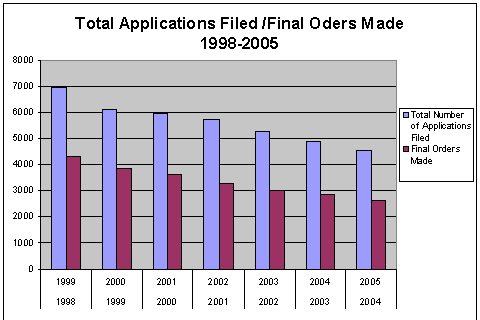
This shows a continuing decline over-time of applications filed and final orders made since the 1998-1999 year.
If you think about the amount of resources and focus that have been put into eliminating “domestic violence ” one would expect to see a reduction in the number of protection orders issued over time.
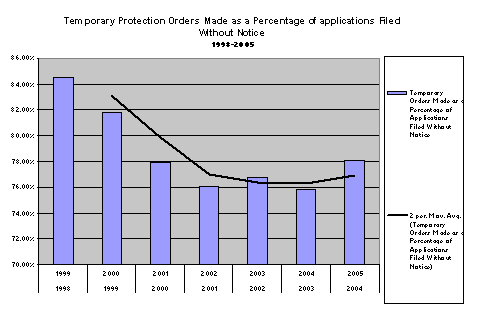
This graph shows that the figure for: Temporary protection orders made as a percentage of applications filed without notice.
The lowest figure is 75.8%. That shows since 1998-99 at least 3 out of 4 applications made without notice are made into temporary orders. While declining for a form a high of about 84% (1998-99) to a low of about 76% (2003-04) the number is increasing.
So if you are a woman and you apply for a protection order without notice 3 out of 4 times you will be granted the temporary protection order.

One final chart and I’ll leave it at that.
It speaks for itself.
Regards
Scrap


Well done scrap and this link just reiterates the damage done by radical feminists like the cadaverous Helen Clark and her evil cohorts .
http://www.newswithviews.com/Usher/david54.htm
Comment by dad4justice — Tue 28th August 2007 @ 1:17 pm
Last night on TV3, John Campbell did a roll-call of all women and children killed in DV incidents since 1995. The total was 220-odd.
Spread over the 12 years, that’s about 18 per year. As the name and age of each victim scrolled by fairly quickly, I was only able to get a glance at the make-up, but I’d say it was about 50% children.
So let’s say we’re talking 9 women and 9 children a year.
I understand that women kill children more frequently than men do, so more than half of these children were victims of female violence.
As the list excluded men victims, it’s very easy to see through this attempt at clouding the issue.
Yet both John Campbell and Neville Robertson both couched DV as a male problem directed at women.
Does anyone have exact figures on a per year basis showing men killed as well as women, and the sex of the killer in all DV killings of men, women and children?
Comment by Rob Case — Tue 28th August 2007 @ 1:41 pm
Good call Rob,
you should send on your observations to John Cambell and advise him that he who asks every question and isn’t frightened of teh truth is misrepresenting those truths, exploiting the kind of fear that keeps him in work, rather than beginning to work responsibily, like us lot have had to do, to compensate for the apathy of return. These people simply not want men to be considered equitably as equal with women, because their industry will be riddled with if not built from such inconsistency.
Comment by Benjamin Easton — Tue 28th August 2007 @ 3:56 pm
James,
great graph! I have an email from Peter Dunne which you will need to see. The complaint is that the gross component removed from earnings, where income tax and child support are equal in that fact, overlaps removing as if gross direct income so disguised fromt he nett component. This is to say it is said to go to the child but it doesn’t where it goes directly to the government from the nett figure.
This is absolutely serious.
The question has been passed on to IRD officials so they are looking at it, but if it comes back to me in any form of responsibility, I honestly don’t want it, it is more on my plate thatn I can effectively handle.
Paul Catton and Bevan both have copies of the question and reply and i am having difficulty with access to the net and recording making it difficult to put up letters of the like. Would you ask Bevan for a copy of the original, or alternatively I will be asking Bevan or Paul to send you their copies (I haven’t kept your e-mail) and prepare by consideration of PD’s comments an assesment for further reply from the Ministry?
If you do this and can figure a stratergy related to the facts then its all yours.
Cheers,
Benjamin.
Comment by Benjamin Easton — Tue 28th August 2007 @ 4:05 pm
Let us look at the issue of Family violence as a product. Refuges, “Courses” and other hangers on are only funded based on the number of clients. Hence Refuges drum up trade by creating a paranoia of “Violence” And lets not forget to walk aeay from an argument is viewed as “Psychological Abuse” Courses are funded by the number of attendee’s. Hence again stir the pot and get protection orders.
My advive is immediately file notice of intention to defend.
The first thing an anger managent course is to demand that it’s “Victim” admits that they have an anger problem.- – hence weakening one’s defence. Ergo a selfperpetuating cycle. Ignore the anger management course, until your defence is finalised or the order becomes permanent. At this point – why bother doing it anyway?
Comment by Alastair — Tue 28th August 2007 @ 5:15 pm
Rob,
Further to your comment the pertinent question to Nev is how many of these listed killings actually had a protection order or application in place.
Regards
Scrap
Comment by Scrap_The_CSA — Tue 28th August 2007 @ 8:46 pm
When considering “domestic violence”, I suggest that if we wish to make life in NZ better, we should keep some form of balance and overview.
>
It is very difficult to obtain accurate perpetrator data. Many crimes by women are not recorded, due to being discharged as first offender. Even so, men are vastly over-represented in perpetration. (All men are….! doesn’t give any value for improving our lives, it is just an obviously dishonest manipulative marketing slogan.)
>
NZ General accident statistics:
>
http://www.nzhis.govt.nz/stats/accstats.html#10
>
Deaths from leading external causes, by sex and age, registered during calendar year 1999
Homicide
Total Male Female
51 39 12
>
Men are over represented in all forms of death other than by natural disease and aging. This includes death caused by another person and death by suicide. Men generally are risk takers. In some respects this is very desirable socially and in some respects it is unnecessarily self destructive. Where decisions are taken spur of the moment or by carelessness, which don’t reflect the persons long term goals, then this may be seen as unnecessary loss.
>
We see that 2/3 of victims of violent death are men. Whether this is acceptable, tolerable or desirable is a matter of personal values. Probably 80 to 90% of the perpetrators were men and it is unlikely that any of the victims consented.
>
A request for information about NZ injuries and hospital stays, provided the following, for 1999:
Information Analyst
Business Intelligence
New Zealand Health Information Service
Ministry of Health
>
9600 Unarmed fight or brawl
Mean Total day
stay stay visit
days days
Total: 2.8 1677 647
Male: 2.9 1353 496
Female: 2.0 324 151
(Sorry that WordPress has put the headings out of line with the data columns.)
Thus roughly 75% of injured persons were men and typically men’s injuries required longer stay in hospital. (Gender of perpetrator not given.)
>
9660 Assault by cutting and piercing instrument
Mean Total day
stay stay visit
days days
Total: 2.9 329 79
Male: 2.9 277 72
Female: 3.3 52 7
(Sorry that WordPress has put the headings out of line with the data columns.)
Women typically required slightly longer hospital stay. Men comprise about 85% of the injured.
>
9670 Child battering and other maltreatment by parent
Mean Total day
stay stay visit
days days
Total: 4.1 45 9
Male: 5.4 25 5
Female:2.4 20 4
Typically boys required longer hospital stays and comprised a little under 50% of the injured.
>
9672 Other maltreatment by spouse or partner
Mean Total day
stay stay visit
days days
Total: 5.8 80 30
Male: 3.8 5 1
Female:6.0 75 29
Typically 90% women victims, with women requiring longer hospital stays.
>
All of these unintentional and intentional injury figures are extremely small compared to suicide and traffic accidents. When dealing with data so small compared to the total population of people in hospital, then small recording errors in the data, might be causing serious misjudgement, if we used the data without some caution. Slight classification errors, can create significant errors in the statistics. In particular, I would suspect (without any hard evidence) that men’s hospital stays due to partner violence may be under-recorded. This could occur by some of these being classified into general assault category. Some such errors could occur due to the victims misreports and some due to adjustment by the people recording the data. (I am not meaning to imply deliberate errors. It is quite common for hospital staff to have relatively little patience with statistics gathering.)
>
Overall conclusions:
Violence is a moderate problem in our community, behind suicide and traffic accidents.
Domestic violence is only about 10 to maybe 20% of the total violence occurring in our community.
Injuries caused by violence are generally less serious than traffic accidents, in terms of average hospital stay.
As violence is a relatively low level problem, solutions must be designed that are appropriate. If care isn’t exercised, the attempted solution might actually cause more problems than it solves.
For example, familycaught actions to restrict access of children to their fathers, while familycaught processes drag on for domestic violence or child abuse, may in fact be causing more social damage by children’s and father’s suicides, than the original abuse ever involved. We could be making the large suicide problem larger and even then not be making much improvement in the smaller domestic violence problem. We could also be making both problems worse?
Similar conclusions might also come from looking carefully at removal of children from their mothers and fathers by CYFs.
>
This suggests that a successful solution will require wise and intelligent judgment based on actual facts (not assumptions), rather than dumb application of assumed standard solutions to wide groups of our population.
>
Comparing the numbers of “Protection Orders” (6,000 per year) to the numbers of murdered (50 per year) and injured men and women (1,000 per year needing daycare or overnight in hospital) and remembering that most of the injuries were not in domestic relationships, leads to the conclusion that “Protection Orders” are being handed out like confetti, by the familycaught “judges”. This is indicative of the general lack of care and lack of skill regarding weighing of evidence, in familycaught. There is a big difference between targeting based on skape-goating and identifying individuals who do pose a material risk to those around them. Legal skills alone simply fail to perform in this area.
>
There seems to be a huge amount of “fear” in our community, where the actual basis for this fear is really quite small. The present hysterical reaction isn’t making NZ safer for men and women, it is more related to moving Government funds into relatively unproductive and unaccountable “social change” organisations. Social improvements will come from targeting of resources at the real problems, accountability and keeping balance around all issues.
>
Fear in correct perspective of real hazards is constructive.
Fear out of perspective damages our society.
Lets get our response in proportion and correctly targeted.
>
This does lead to serious concern that there is very little “judgment skill” being applied, in the decisions regarding “Protection Orders”. Perhaps we should be looking much more carefully at the types of people and the training that we require, before someone is appointed as a familycaught judge. We do need people with useful skills in these jobs.
>
It is interesting to note that the murder rate per population has been remarkably constant for nearly 100 years. This is through years of plenty, years of economic hardship, through years of war. Through this period, there has been major social change due to economic development and immigration, huge developments in medicine and especially in psychology and pharmacology, yet the murder rate stays relatively constant. Through this period, NZs rate of imprisonment has increased and fallen with the need to fill prisons that have been built, but the murder rate has remained surprisingly constant.
>
Murder is a very small fraction of the deaths in the population, thus more reflects conditions of psychiatric health and stress in a very small fraction of the wider community.
This suggests that murder and extremely violent assaults will not respond significantly to generalised treatments aimed at the wider community. To obtain worthwhile improvement, treatments need to be focused on individuals with psychiatric problems, especially relating to violence and the treatments must be relevant to the needs of these people. Frustration is usually a key ingredient. This might be reduced if the familycaught contributed to solving problems and likewise can be increased when familycaught decisions lack relevance and constructive value in the real world.
Thus the concept that familycaught judges operate by, that children should be given to women and that all men should have access to their own children restricted and broken, may in fact be doing individual children and our society considerable harm.
For example, children separated from their fathers typically show higher risk of the following problems:
girls reach puberty 12 to 18 months younger
younger puberty increases the risk of teenage and younger pregnancy
general and sexual health is typically poorer
boys do more poorly at school and in many other long term focused activities
both boys and girls later show poorer market employment development
both boys and girls show much increased risk of suicide and psychiatric problems
Thus, restricting access of children to their fathers is not the “no damage” situation, that these familycaught judges assume, through their lack of knowledge about society and lack of care. Damage is done to the children and to the fathers. Where it is the mother that is removed, then the same applies likewise.
Medical doctors always plan treatment, on the basis of assessing the measured risks and the measured benefits with a professional level of skill and always try to learn from any mistakes made, as quickly as possible.
If familycaught judges received professional level training, relevant to the types of “decisions” that they were making, then the familycaught performance would start to improve reasonably quickly.
Sir Ron Davison may have meant well, but his “research” into the causes of domestic violence were more expensive than professional. His assumptions about treatment and who it should be given to, were guesses, based on good intentions rather than professional level research skills and statistically significant sampling followed by collection of true facts. Although I am heaping scorn on his efforts, as being unprofessionally cost ineffective, I do acknowledge that research into issues relating to very small (difficult to identify before the fact) sections of our community are very challenging to perform successfully. He is a professional legal worker, not a professionally trained social sciences researcher. They just employed the wrong guy!
The road to hell is paved with good intentions!
Spending money on getting a legal worker to investigate domestic violence not only didn’t achieve much, but it soaked up money that would have gone much further, if it was spent on professional social science researchers. I believe that Sir Ron received about $500,000 for a month or two’s work. The same money could have obtained about 10 years of social research work.
>
familycaught performance issues need to be professionally evaluated, in a public Commission of Enquiry into the operation of the familycaught, if we wish to break the cycle of abuse of Government money by legal workers.
Don’t gamble with your children, in the familycaught.
Cheers, MurrayBacon.
Comment by MurrayBacon — Tue 28th August 2007 @ 11:03 pm
the Family Court must stop as the damage to the children is HORRIFIC and I just spent 9 hours straight with child abuse police . Boshier I will have you made accountable and Helen Clark you should not have fobbed me off !!! Without prejudice .Peter Joseph Burns .
Comment by dad4justice — Tue 28th August 2007 @ 11:09 pm
The tears of blood generate through the cold hard walls of the Family graveyard Court .
Comment by dad4justice — Tue 28th August 2007 @ 11:11 pm
To summarise:
In 1999, there were about 4,000 Protection Orders issued permanently, for 12 domestic murders and about 150 injuries requiring hospital treatment. This is a shotgun approach – shoot anyone or anything in sight!
So what?
There were obviously some 3800 wrong hits, with familycaught doing at least some social damage.
For all of the shots, barely a single shot hit the right place, resulting in 1 less injury or death.
Was anything positive achieved?
Through the time the Domestic Violence Act has been in force, there has barely been any measurable reduction in domestic violence. What reduction has occurred, would appear to be related more to society wide reductions in violence, than the effects of familycaught “Protection Orders”.
Thus the evidence points to familycaught intervention being expensively spectacularly ineffective.
Who is surprised?
Successful medical or social interventions come after the strategy is devised, based on careful, good quality research.
Doing something unsuccessful (“Protection Orders”) more or harder, only makes the situation worse.
The familycaught has thus far protected itself from public accountability, allowing its destructive performance to roll on.
If we want to improve these social problems, then we do need to investigate the causes and work out interventions that give measurable benefits and at acceptable measured social cost. This will never happen by accident. It will only happen, when the process is managed by people who know what they are doing!
Just do it! MurrayBacon.
Comment by MurrayBacon — Wed 29th August 2007 @ 8:23 am
Murray,
This is a superb post (comments 7 & 10)- in its presentation of facts, its straightforward diagnosis of dysfunction within our systems and its common-sense prescription for remedy.
It really deserves wider circulation.
Comment by Rob Case — Wed 29th August 2007 @ 2:20 pm
Murray,
I’ve posted your comments here on the Mens Activism Wiki. Please take a minute to look it over for proper representation (I had to do some editing).
Comment by Rob Case — Tue 4th September 2007 @ 3:57 pm
Thanks very much for the tidying up. I really appreciate your teamwork. More to come, but it needs very careful checking before publishing.
Best regards,
MurrayBacon.
Comment by MurrayBacon — Tue 4th September 2007 @ 5:35 pm
After reading the Protection Order figures, imagine my suprise when searching under the Info and Resources section and seeing “Auckland Lawyer Martin Hine” listed. I have been on the receiving end of his “Families Matter”.
He is a beneficiary (and refugee) specialist, concerned solely with extracting the maximum return from the Legal Services Agency. He encouraged my ex to apply for a Without Notice Order for Protection citing, inter alia, my telephone call to my 3 year old on her birthday. He simultaneously filed two other bizarre orders, also dismissed. The application was thrown out by the judge with an order for my costs. He didn’t even pitch up for the Court hearing. My ex was livid!
Use this man at your peril. He is aggressive, inflamatory, sporadic and well known at the North Shore Family Court. And not in a good way.
Comment by PaulN — Fri 28th December 2007 @ 11:08 am
All these anti-father laws are common to the Industrialised world, nothing is particular to NZ . They are beginning to take account of fathers very slowly but NZ will be one of the last to follow. NZ Fathers have moved on, these laws have not, in NZ they are becoming increasing draconian (police issuing POs is next , well who is the biggest of the couple ?). However the domestic violence “industry” is getting bigger and bigger all the time. Right wing parties will be the only ones to start turning these laws back (unfortunately).
Comment by DadsWillPrevail — Tue 1st January 2008 @ 8:46 pm
According to the NZ Police website (http://www.police.govt.nz/safety/home.domesticviolence.html#gettingaprotectionorder), one can apply for a protection order if (s)he is a victim of Domestic Violence. The website defines Domestic Violence as being:
“not only a fist in the face or a kick in the head. The law says that violence can be physical, sexual or psychological. Physical abuse. Nobody – including a husband, wife, partner, or an adult who looks after children – has the right to hit, punch, kick or in any way assault another person. Sexual abuse. Nobody is allowed to have any sexual contact with another person without permission. Psychological abuse. This includes intimidation, threats and mind games. Below are just a few things that the Family Court recognises as psychological abuse:
– damaging property as a way of hurting someone
– making threats, such as “If you leave, I’ll kill you”, “Do that again and I’ll give you a hiding”, “Tell the Police and I’ll beat up the kids”
– allowing a child to see or hear any domestic violence
– trying to control someone’s life by constantly humiliating them
– controlling someone’s money, time, car or contact with friends as a way of having power over them”
According to the definition, my partner, C, is a victim and has every right to apply for a protection order against his ex-wife, V. During their marriage, she was psychologically abusive, calling him names, humiliating in front of others, constantly swearing at him, threatening to kill him or their 2 sons (who’ve just turned 4 and 10 years old), telling his friends and family horrible untrue stories about him, stalking his female colleagues at work, etc. While they were married, C was afraid that V might kill him in his sleep and he had evidence that she meant to physically harm him.
Since their separation well over a year ago, V has continued to do all this; but, she has gotten worse. For example, she has repeatedly threatened to kill the children. She has refused to feed the children stating that their father hadn’t paid child support although he does pays child support via IRD and then pays for supposed extras for the children. She was sending them to school without lunch. She has knowingly talked inappropriately and negatively in front of the children about their father and she has even told them (and others) that he is a paedophile and sexually abusive. On once occasion last year, when C walked the older son to school, at her request because she supposedly wasn’t able to, she suddenly drove up next to them on a busy intersection, got out of the car, and was screaming at the top of her lungs for help because “this strange man” had just kidnapped her son. The son, who was 9 years old at the time, understandably, was quite distraught.
We can not seem to escape my partner’s ex-wife. V sends e-mail messages and text messages on a daily basis — sometimes numerous times a day. The messages are abusive and full of spite, name-calling, and threats. Sometimes she sends these messages verbally via the children. V has even turned up at my work, wanting to fight and cause a scene. Because of this and the other abuse I have received from her, I am afraid for my own personal safety.
From what I understand, V has always had a bad temper and has always been aggressive. She even had a restraining order filed against her in 2005.
Anyways, when my partner asked his lawyer if he could apply for a Protection Order, he was laughed at. She told him that he wouldn’t get one because he’s male. She added that he should be a “big boy” about it. I was horrified to hear that Protection Orders were so gender-based. Shouldn’t they protect everyone, regardless of who they are and their background (i.e., gender, age, ethnicity, soci-economic status, etc.)? I realise that women are often the victims of abuse and domestic violence; but, does that mean men are automatically disregarded? Does that mean a man who is being abused is less important than a woman in a similar situation? Or does it mean women are not capable of being abusive and a danger to others?
Interestingly, C contacted CYFS about their 2 boys. He was and still is concerned about their welfare, especially since we had reason to believe V was interfering with the older son. She had sent us a text last year stating that she had spoken to the older son and that they were worried that his penis was too small for sex. We had noticed that the older son was obsessed about sex, used vocabulary words that you wouldn’t encounter normally (not even on TV late at night), avoided using the toilet and soiled his pants. We also found out from him that he was watching movies and TV programmes that are entirely inappropriate for children. The response from CYFS was that they would take note of it; but, that they wouldn’t do anything about it because they were going to look at it as a custody issue.
Please note that C loves his children very much. He has offered to take the children full-time and to do it without receiving any child support. But, he is scared to apply for a parenting order because V has told him that if he does and if he takes away the child support income that comes with having the children, she would accuse him of all sorts of things. Plus, his lawyer advised him that mothers often get the children so not to really bother as it would cost too much money and time and because her false accusations might lead to possible negative repercussions where he would never see his children again.
Comment by Supportive Partner — Thu 10th April 2008 @ 3:59 pm
Above, scrap has given data on Protection Orders being issued.
I have followed on with a comparison of hospital injury data, to show that the vast majority of the “Protection Orders” are not justified in terms of real world injuries. Thus they are more related to “bashing the man” for some reason, most probably malice with ignorance for icing on top.
The ultimate justification for this “bashing”, is that it is worth it to save lives!!!!???? So lets look at the best statistics that I have been able to find, though they are not as precise as would be desirable.
DV Act – Women and Children’s Lives Saved Per Year
Summary:
Reference: Relationship between homicide and mental illness in NZ
This data includes men and women domestic homicide victims
This reference does not allow homicides before and after 1995 to be totalled separately.
1988 to 2000 ie 12 years Number per year
partner past or present 117 9.75
Family member 132 11
total domestic homicide 249 20.75
total homicide 985 82.083
Robertson Neville Waikato Law School DV cutting edge
This reference addresses only women and children victims of domestic violence.
Neville Robertson, Ruth Busch, Radha D’Souza, Fiona Lam Sheung,
Reynu Anand, Roma Balzer, Ariana Simpson and Dulcie Paina
Commissioned by the Ministry of Women’s Affairs
AffairsAugust 2007
Dedication on pages 3 to 8
Dedicated to the 212 women and children who have died in domestic violence homicides
since the enactment of the Domestic Violence Act 19951.
total w+c
WomenChildren per year
page 3 1995 4 5 9
page 3 1997 10 11 21
and 1996 too ???
page 3 1998 11 11 22
page 4 1999 5 10 15
page 4 2000 9 10 19
page 5 2001 10 10 20
page 5 2002 8 9 17
page 6 2003 6 7 13
page 6 2004 5 14 19
page 7 2005 18 5 23
page 7 2006 9 12 21
page 8 2007 6 3 9
totals 101 107 208
Women+Children domestic homicides per year 17.33333333
Estimating lives saved by DV Act:
If we assume the long term rate of homicide is constant, then we can take the difference between homicides in 6 years before DV Act was passed and subtract homicides in 6 years after DV Act was passed, as being the numbers of lives saved.
(More exactly, the homicide rate was slowly increasing, through the 2 decades before the DV Act was passed, so the estimation procedure above will tend to slightly underestimate the lives saved. In any case, the number of lives saved per year is a very small figure, say under 1.5 per year?)
Womens and childrens homicides in 6 years 1995 to 2001 106
Womens and childrens homicides in 6 years 2002 to 2007 102
Lives saved in 5 years since introduction of DV Act: 4
Lives saved per year since introduction of DV Act: 0.67
The maximum number of women’s and children’s lives that could have been saved was about 17 lives per year. Thus the reduction in homicides is not statistically significant, particularly when compared to the draconian measures implemented in the hope of obtaining a reduction in domestic murders.
This is especially so, when it the breaches of natural justice were expected to save large numbers of lives
Robertsons data appears to be consistent with the Justice Department data, but accuracy cannot be precisely checked, due to the incomparable basis. (W+C versus W+M+C)
Reference: Relationship between homicide and mental illness in NZ
This data includes men and women domestic homicide victims
This reference takes an extremely narrow definition of Serious Mental Illness (SMI).
It defines SMI as legally unfit to plead, thus is much narrower than either a layman’s definition, or a medical practitioner’s definition.
If the latter definition is used (see 1999 Prevalence of Psychiatric Disorders among NZ Inmates) then over 80% would be considered to have SMI (probably 100%).
Table 10. Victim characteristics of mentally normal and mentally abnormal homicide, 1988 to 2000
Characteristics Victims of normal Victims of mentally abnormal
of victim offenders (n = 842) offenders (n =73)
n % n %
Gender
Male 317 38 32 44
Female 189 22 29 40
Unknown 336 40 12 16
Age
0 — 9 49 6 15 21
10 – 19 55 7 2 3
20-29 146 17 3 4
30-39 98 12 5 7
40-49 62 7 11 15
50-59 42 5 5 7
60-69 44 5 12 16
Unknown 346 41 20 27
Relationship to offender Total
Partner — past or present 105 12 12 16 117
Family member 89 10 43 58 132
Friend 27 3 3 4 30
Acquaintance 179 20 14 19 193
Stranger 82 9 2 3 84
Unknown 456 50 0 0 456
Total 911 100 74 100 985
Also see:
1999 Prevalence of Psychiatric Disorders among New Zealand Inmates prisoners justice department
NZ DV Act Cost Benefit Summary
Lives saved per year women and children only 0.67 lives per year
Lives lost fathers and children committing suicide -23.76 lives per year
(These suicide statistics will be presented in a future comment.)
Total lives saved -23.09 lives per year
Total cost to Families and Government 42 $million
Cost per life saved -1.767816273 $million per life saved
An expenditure of $1.76 million per life LOST!!!!
This data shows that familycaught isn’t efficient as a killing machine!
For comparison, road safety projects are authorised for expenditure up to +$2 million per life saved.
It seems that the DV Act, in trying to save up to 17 women per year, saves about 0.6 per year. The consequential losses include fathers and children’s suicides, at about 20 per year. All this, while turning a blind eye to men victims of homicide, at around 100 per year. I believe that it is important to maintain a sensible overall perspective!?
This post is extracted from a submission that I made to Justice Department, in February 2008. (They haven’t acknowledged receipt.) If you would like a copy, email me and I will send it in return. It is about 4 MBytes. The submission also examines the research about DV and shows that the DV Act is based on research up to about 8 years before the act was passed. If up to date research had been read, then this act would never have been passed. This leads to the conclusion that NZ Parliaments are not safe enough, to be allowed to pass legislation written in NZ! The submission included extracts from the research, to show these points.
Are you comfortable about the performance of this Act?
Best regards,
MurrayBacon.
Comment by MurrayBacon — Sat 28th June 2008 @ 4:53 pm
Gentlemen – I had not noticed this discussion and detail before – I take my hat off to you all – You have clarified much that we have talked about over many years – Please excuse my lack of faith in current powers that can effect change but do you really think your hours of work and presentation will achieve much – It is fairy clear that those in power want whats happening to our families and the work that gives the Court and bureacratic beneficieries?
Onward
Ration Shed – Jim
Comment by Jim Bailey — Sat 28th June 2008 @ 7:33 pm
I suggest that the education about domestic violence – which began in earnest in the late 1980s, if I recall? – has had the result that men don’t dare raise a hand like they used to. So it is doing what it was meant to do. Why stop educating people, therefore?
I am from a different country and despite a big posing stance by the government of being PC, I found gender relations here were stuck in the 1950s. The men treat their women like rented mules.
Comment by Jane Smith — Sat 1st November 2008 @ 4:17 pm
Dear Jane
I suspect ytou speak of your own personal experiences and relationsips and I am sorry for that. You say you are from a different country. So you know what gender relations were like in NZ in the 1950s?
I was brought up by a solo mother during this period who worked as a university lecturer and passed onto me the joy of learning. My mother never felt like a mule, while my father was still alive I never saw him disrespect my mother once.
You would know therefore NZ was the first country in the world to give women the vote – long before the 1950s, it had the first woman MP, had the most women MPs per capita, and the world’s first transgender MP. There was a time very recently when the Prime Minister, the Chief Justice, the Governor-General, and the Speaker of the House were all women.
You miss the point totally about the violence women commit, especially against children. The point we are trying to make is that domewstic violence is not solely a male problem. Your argument is flawed and simplistic, the way the Family Court would also choose to portray it. I hope you don’t get to experience the Family Court, but if you do the first thing you will notice is that your ex-husband or partner will be the only man involved in the process, all the officials, all the experts, all the lawyers will be women like you. So you will get justice, empathy and all the support you need.
As for your partner, he will be on his own, and like a mule receive a damn good legal thrashing from the Family Court system – which operates in this country on the same principle as NZ’s official view on the issue of racism – it is impossible for an “opposed” sector of society to be racist, it also held here by authority that it is impossible for a man not to be violent in a relationship break up. Women who commit violence against men and children are treated differently than men who commit the same offences. You may disagree, but the facts presented prove you wrong. We men must be big boys and just take it on the chin.
Gerry
Comment by Gerry — Sat 1st November 2008 @ 7:47 pm
Dear “Jane”, I liked your brief observation about NZ men. A simple and usefull observation, about simple and not so usefull men.
There might value in noticing individuals as well as the averages. I married an individual woman and since then I have been pleased that I didn’t marry the average woman. Its just not possible to divorce an average woman, only an individual.
“Jane” sounds awfully average. Cheers, MurrayBacon (1 of 6,000 per year…)
Comment by MurrayBacon — Sat 1st November 2008 @ 8:24 pm
The point of this thread (why do we always have to spell simple things out to women ?) is that there has been very little differences in calculated “Domestic Violence” behaviour, but the devastation that these laws have made to millions of kids, fathers, yes and society in general, is VAST.
It is the same as the old turkish police method of torturing 1000 people to find out the 1 real offender , but women never really understand “statistics”. because they never think that they are wrong, do they ?
Comment by Perseus — Sun 2nd November 2008 @ 12:05 am
Unfortunately the barrier in these issues, doesn’t lie in women’s understanding, it lies in the “average” mans trust in the caught system and “judges” in particular.
I had this view myself, before I had met the familycaught “judges” in person.
OK, so I was convicted of a speeding offense, by the perjury of a traffic policeman. I was guilty. No great injustice, worth complaining about. So I lazily assumed that most convictions gained by perjury, were probably justified anyway.
The trouble is, when you lower standards of proof, or in a dull and stupid manner, allow convictions to proceed with no other “evidence” than sympathy and an accusation, then there will be large numbers of false convictions.
When these wrongful convictions result in severe family damage, such as for Arthur Allan Thomas, or Walter Bolton, 18 February 1957 and now hundreds of thousands of other examples too, then we are seriously damaging our own society.
It is very important to actively check for conflicts of interest, in our “judicial” process. The present “trust us” mantra, is an obvious cloak for skullduggery and judicial murder. Achieving quality starts with operating working systems of accountability, not just paying the Judicial Complaints Hider (JCC) a salary, irrespective of the quality of his “work”, or lack thereof.
Many people oppose the Government paying damages for wrongful conviction and incarceration. However, doing this helps to make the social costs obvious and therefore easier to manage. As these costs escalate and become expensive to taxpayers, then there is constructive pressure to set and apply standards for all legal workers, in particular for judges.
There must be many wrongful convictions that never become obvious to the public. The DNA exonerations is one of the few examples where new forensic techniques allows the resolution of some old cases. This then gives a MINIMUM estimate of the proportion of wrongful convictions.
It does make a case for setting minimum standards for judges training and standards of integrity. At present, our “judges” are “all care and no responsibility”. Their role is more of theatre/clown – someone is hanged or jailed and the public aren’t too concerned about who! It seems that the clothes matter more than the man.
The european standard that people who have worked for over 12 months as a lawyer, are ineligible to enter judicial training, in my opinion is essential as part of setting integrity and ethical standards for judges.
It is only if the series of rapes continues unabated after the jailing, that a search for further people to incarcerate is started again.
Improvements will come from:
1. Listening to the evidence
2. Having the necessary skills to understand and evaluate evidence
3. Approaching these tasks with an open mind
None of these ideas is new, they have been described for thousands of years.
There is quite a lot of value to society in incarcerating the right people.
Lets start with some of our present “judges”.
The “profession” that doesn’t set performance or quality standards and fights against allowing its members to be subject to penalties for unethical or incompetent conduct, coincidentally is the “profession” that is developing it’s standards the slowest of any! The solution is pretty obvious!
Cheers, MurrayBacon.
Comment by MurrayBacon — Sun 2nd November 2008 @ 9:35 am
While a Protection Order may have it’s merits, how they are attained, is the prime concern.
For starters, there is a “conflict of inrerest” upon the issue of every Protection Order as a lawyer / legal firm only has financial interests when preparing a Protection Order. How more corrupt can you get i ask ???
I believe that a hospital / doctor should be the only authority to support the weight of evidence for the issuance of a Protection Order, even if it requires that a lawyer (on salary) have his own office in each of the nations leading hospitals.
These Protection Orders are handed out like toilet paper every time a lawyer or family court jugde needs to do a shit, fuck the lawyers and fuck the judges who are part of this corrupt family court industry, you filthy theiving bastards.
Is nothing sacred ?
Comment by Colin of Nazareth — Sun 2nd November 2008 @ 10:41 am
Some people find money to be sacred. I advise to try as much as possible to give them a wide berth.
Don’t travel alone through downtown Auckland at 3 am, unless worthwhile or necessary, its just asking for unnecessary trouble.
Same for familycaught and all who sail in her.
Cheers, MurrayBacon.
Comment by MurrayBacon — Sun 2nd November 2008 @ 11:39 am
Yes Murray, “beware the rubber stamp salesman”, whether it be 3:00 a.m in downtown auckland or the corridors of power, they call the family court. Not much difference on the danger scale, you’re bound to get screwed either way if you are not extra careful…
No Solicitors
Comment by Colin of Nazareth — Sun 2nd November 2008 @ 12:45 pm
In my case, the protection order my lovely wife took out on me, was simply used as a legal extention of her previous PHYSICAL violence against me, i realise now, and she got away with it. As a result of this P.O, she got the kids, the house, the beautiful Indonesian furniture ! The law and the police just let her do it, male power being used against males (as usual).
The number of males murdered by women has dropped more than the number of females murdered by men since “Domestic Violence” laws were brought in.
This was not due to calming of these sweet ladies made of sugar and spice.
NO, the reason is because, violent women like my wife now have an alternative to murder, they can now just pick up the phone and call the police to get the husband thrown out of their life. They can cause even more longlasting mentally cruelty this way too ! Murder is no longer necessary.
But a violent woman will NEVER change.If her next partner ever retaliates, she will kill him ! I predict this, Claire Rudasingwa NOW living in Brussels, Belgium, will kill her next husband. I TOLD YOU SO, google this one day !!!!!
I went to the police and they only believed her and told me that “In NZ Domestic Violence is done by the man”, although it was me who was attacked. I had paper police statements of her previous violence. But all she had to do was lie and say that it was me who had been violent, i could have easily been arrested myself, as 20% of men are.
Comment by Martin Swash — Mon 3rd November 2008 @ 3:51 pm
I told her Maori friend, Maria from Miro Road,Raumati South and Brent her boyfriend, about Claire’s past violence and that i had never touched her only argued with her. They work as counsellors , AND they said to me “Words are worse than punches” ! Obviously they had never been attacked with cricket bat or nearly lost an eye
I suppose that i am lucky to have her out of my life, to no longer have the violence, the addiction to her false charm and sexuality
It is not the personal trauma of relationship failure that has changed my life so drastically, it is the trauma of being abused by the state and the great great injustice of what i faced and having all your words digested, turned upside down and ultimately ignored. You expect justice, that right should prevail in an Anglo-Saxon country, but all you get is , well, what the Jews would have got in Nazi German courts in the 30s
Comment by Martin Swash — Mon 3rd November 2008 @ 4:28 pm
Justice and the Family Court are like oil and water. The Government should be honest and change the name to the Protection Order Court for Women. I was told today it would take several months to have a guardianship issue brought before the North Shore Family Court in Auckland because of the focus on Protection Orders there. The Family Court is affecting the safety of my children. All this stuff about the best intersts ands welfare of children is crap. The Family court is about taking it out on men. It actually only cares about children when they can be used against the father. If they actually did care about children guardianship issues would be a priority.
Judge Ryan – the socalled Administrative Judge of the North Shore Family Court is a complete toady for the women’s movement, asking all men facing a protection order if they have a problem with women. The answer should be “no I just have a problem with Judges who are an apologist for the femninist movement and an incompetent court system that is groaning under overload.” Fat cats like Ryan have the power to actually do something about improving the turnaround time at the Family Court, but they don’t have any other interests other than sucking up to the women’s movement in order to look PC.
Comment by Gerry — Sat 15th November 2008 @ 12:21 am
Murray – excellent posts!!!
John P – is there a part of the web site we can store these kind of statistics and reasoned analysis?
Comment by Dave — Mon 17th November 2008 @ 5:05 pm
This man sounds like the typical deluded respondent. I have no recollection of his case and suspect that he has not at all accurately reflected either the application or the outcome.
Comment by Martin Hine — Fri 22nd May 2009 @ 8:09 pm
Martin Hine (legal worker) suggests that PaulN is deluded. However Martin cannot recollect the case, even with all of his files to refer to, so I am concerned that PaulN might just be correct?
T’is better to be thought a fuel, that to open your cakehole and remove all doubt!
Thank you for your entertainment, MurrayBacon – axe murderer.
Comment by MurrayBacon — Thu 5th January 2012 @ 10:39 pm
air conditioning installation houston – I hope you do’t tell your customers “All I hear is a bunch of crying about something that you can fix if you were not too busy seeking attention.”
Installing Air Con is easy, something any NZ’s could do.
Fighting for your family (do you have a family?) is a whole different ball-game when you have the Police, the Law and Social Services all against you. Hope you never have the experience! Have some respect for those of us who do have to fight!
Comment by John Brett — Tue 10th July 2012 @ 9:10 am
Mr Martin Hine
Your response idicates that you are no longer fit to represent men in the Family Court. If respondents are “typical[ly] deluded”, then I find that you are prejuducial in your dealings with them, and a sad representation of your oaths to uphold justice.
If your memory is so fragile that you “have no recollection of his case” (and, seemingly, any inclination to read up your files), then you clearly are not fit to practise law.
Please see me in my office.
Comment by Family Court Judge — Tue 10th July 2012 @ 3:35 pm
#34..and it took you 3 years to respond..can see why the wheels of justice are so damn slow
Comment by Ford — Tue 10th July 2012 @ 3:39 pm
Thanks Murray.
And thanks Mama for the link.
You guys used to chew some real fat.
Comment by JustCurious — Mon 29th October 2018 @ 6:07 pm